Friday, January 24, 2014

3 Question Blog #8

What tasks have you completed recently? 
This week has been so so busy. I was one out of ten students in New Mexico to be chosen to be an Enalce Legislative Intern. So this past week I've been in Santa Fe getting private tours in the Capitol. The experience was amazing and such a great opportunity. From 6:30 in the morning to 9:00 at night it was non stop, running around the Capitol shadowing senators and representatives. I got to shadow Representative Rick Miera, Repreaentative Alonzo Baldonado, and Repreaentative Bill McCamley. 

What have you learned recently ?
I learned a lot on this Ingernship. I now kind of understand how the political world works, and let me tell you... It's chaotic. You have senators, representatives, presidents, guests, and many people passing by you. When I got to be on the floor of the roundhouse it was a whole different level of how these important people work. For example, I'm used to giving all my respect and attention to who ever is speaking, and down in the round house it was weird to see how everyone just gets up, walks around, mingle with others, walk in and out, while the speaker if the house is speaking. But I guess all I can say is they're important, busy people getting their business done.

What do you plan on doing next ?
I'm planning to get caught up in all my classes as my number one priority !! I was gone for a whole week and I feel like the world is crumbling down on me. I feel so behind in everything. Even though I tried my best to do my work up in Santa Fe but there just wasn't enough time. Anyways I'm just going to focus on catching up for sure. 

Sunday, January 5, 2014

Hip Dislocation

A dislocation is an injury to a joint, where the ends of your bones are forced from their normal positions. When this occurs it temporarily deforms and immobilizes your joint and causes pain. The hip joint is a ball-and-socket joint. It is formed between the ball of the femoral head and the socket of the acetabulum. To keep the joint stable, it consists of the fibrous joint capsule and ischiofemoral ligament. When a hip dislocation occurs the top of the femur moves out of its normal placement in the socket (pelvis). Most of the time the femur is pushed out in a backwards position (posterior dislocation), it is bent and twisted in toward the middle of the body. It can also be a forward direction (anterior dislocation), where it is bent only slightly and the leg will twist out and away from the middle of the body. There are two types of hip dislocations: congentinal or traumatic. When it's a congentinal hip dislocation, it is caused by dysplasia of the femoral head or acetabulum. A traumatic hip dislocation is a medical emergency and needs to be treated immediately because the injury can cause blood to stop reaching the femur, depriving it from vital oxygen supply. It is unlikely for a hip dislocation to occur during athletic events but is possible. Usually hip dislocations are caused by high impacted car accidents and falls from high places. When you dislocate your hip you minimize the movements you were capable of doing, for example; adduction, abduction, walking, jumping. running, you pretty much have limited mobility, but its temporary. There are many treatments you can do for a hip dislocation but the most important one to do first is put the hip joint back into place, that could be done at the doctors/hospital. If it's serious surgery can be done they can also determine if you also have a fracture, if so, then you will be put in a hip abduction brace. If the injury isn't as serious you preform R.I.C.E- rest, ice, compression, and elevation and also take, inflammatory/narcotic medications to reduce the amount of pain. Physical therapy for a hip dislocation will start with weight bearing by using crutches or a walker. Physical therapists will try gait training so that after the injury they can slowly regain the feeling of putting more weight on the hip and learning how to walk again. With that comes also stability to work on improving dynamic stability of the hip joint. Range of motion would be used to restore the range of motion of the hip to help heal the ligaments and muscles. Strengthening the hip joint by doing simple exercises. Last but not least progressing the functional activities with daily life exercises like walking up and down stairs, squatting, kneeling, getting in and out of the car, stretching, lunges, etc. Once it is more stable and strong you can try returning to athletic functions/performances at a low level and than progressive.
      
http://healthfavo.com/wp-content/uploads/2013/07/anterior-hip-dislocation-on-healthfavo.jpg
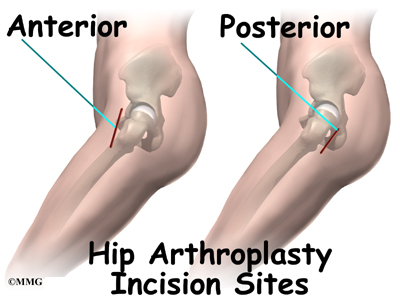
http://www.eorthopod.com/sites/default/files/images/hip_artificial_precautions_incisions01.jpg
http://www.drugs.com/health-guide/images/204825.jpg

References:
http://www.wisegeek.com/what-are-the-symptoms-of-a-hip-replacement-dislocation.htm
orthoinfo.aaos.org/topic.cfm?topic=A00352
http://www.patient.co.uk/doctor/Hip-Dislocations.htm
http://twinboro.com/body/hip/conditions/hip-dislocation-nj.html
http://emedicine.medscape.com/article/86930-treatment